
I INTERNATIONAL COURSE ON COLLAPSE CALDERAS
30/9-02/10/2010 (Reunion Island)
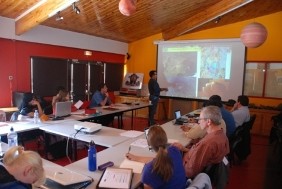
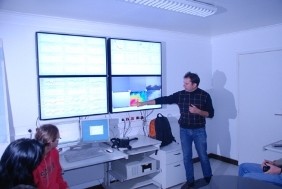
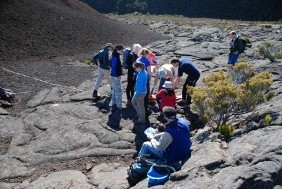
As part of the next workshop on calderas to be held in La Reunión Island, France, at October 3-9, 2010, the Commission started as a new activity the implementation of the International Course on Collapse Calderas. The course took place just before the workshop and consisted of two days theoretical lessons (September 30-October 1, 2010) and one day field trip (October 2, 2010).
The course consisted of introductory modules concerning formation and development of collapse calderas, principal products associated to caldera-forming eruptions, as well as an actualized classification of calderas. Following these modules they focused on numeric and analogue modeling, monitoring, and the case study of Reunión Island. The course ended with a day in the field to visit field examples of deposits and structures related to caldera-forming eruptions and instrumentation for monitoring caldera unrest signals.
 PROGRAM | TEACHERS |
| Prof. Joan Marti Module 1: General concepts of collapse calderas Module 2: Dynamics of caldera-forming eruptions | |
| Prof. Ray Cas Module 3: Field studies on Collapse Calderas | |
Dr. Valerio Acocella Module 4: Analogue models on Collapse Calderas | |
Dr. Adelina Geyer Module 5: Numerical models on Collapse Calderas | |
Dr. Anthony Finizola Module 6: Geophysical imaging on collapse calderas | |
Dr. Andrea di Muro Module 7: Monitoring collapse calderas | |
| Dr. Laurent Michon Module 8: Case-study Reunion Island |
II INTERNATIONAL COURSE ON COLLAPSE CALDERAS
19/9-23/09/2012 (Bolsena, Italy)
The Course will consist of 2 days of theoretical lessons (September 20 and 21) and 1 day of field trip (September 22) at Bolsena caldera.
The main objective of the Course is to offer the students introductory modules concerning formation and development of collapse calderas and principal products associated to caldera-forming eruptions. Following these modules, we will focus on the topics that can best be applied in the coming workshop, such as numeric and analogue modeling, monitoring, and the case study of Bolsena. The course will end with a day in the field to visit examples of deposits and structures related to caldera-forming eruptions. The course introduces to the state-of-art of research and monitoring techniques on collapse calderas and will be held by scientists from several research institutes.